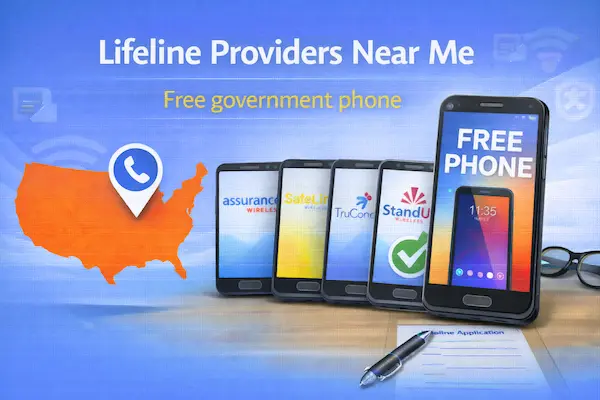
Lifeline providers near me – Free government phone
Find Lifeline providers near you, compare coverage, data, and phones, and apply online confidently today.
You’ll also see common search phrases like government phone companies and government phone service providers, and you’ll understand exactly what they mean.
Notice: This content is independent and has no affiliation, sponsorship, or control over any company, carrier, platform, or third party mentioned.
Program rules and plan details can change, so always confirm current terms directly with official sources and the provider you choose.
Lifeline providers near me: what “free government phone” usually means
When you see “free government phone,” it usually means a Lifeline phone service provider is offering a promotional device alongside Lifeline-supported service.
Instead of the government handing you a phone directly, you’re typically choosing from lifeline service providers that participate in the program and serve your location.
Some offers include a device, while others focus on the monthly service discount, so it’s smart to compare the whole deal.
Because people want simple answers, many searches include “free” language, such as free lifeline phone service providers, even though the details vary by state.
If internet access is your main goal, you’ll also run into lifeline internet providers, which can be especially important for school, work, or telehealth.
Lifeline providers near me: the fastest way to find real options in your area
The fastest way to find Lifeline providers near me is to filter by your state first, then confirm availability in your ZIP code.
Availability matters because some providers only operate in certain states, and even within a state, coverage can shift by neighborhood.
To make your choice easier, start with this deeper guide: best Lifeline providers near me (how to choose).
From there, you’ll narrow your list to providers you can actually activate today, without wasting time on offers that don’t apply to you.
Quick reality check before you trust any “near me” result
Many “near me” search results are ads, not confirmation of service in your exact area.
To stay in control, verify these details before you apply or share personal information.
- Confirm the provider serves your state and can activate service in your ZIP code.
- Ask which underlying network the provider uses where you live.
- Check how much high-speed data you get before speeds slow down.
- Look for any fees like shipping, SIM replacement, or activation charges.
- Make sure support options are clear if your SIM or phone stops working.
Coverage comes first: why “near me” is really about your network
Coverage is the biggest deal because a “great plan” means nothing if your calls drop at home.
Many lifeline cell phone providers operate on major carrier networks, so the provider name may not match the network powering your service.
That’s why you’ll see people search for phrases like verizon wireless free government phone or at&t wireless free government phone.
In most cases, the person isn’t asking for a Verizon- or AT&T-branded Lifeline plan everywhere, but for a Lifeline provider that uses that network locally.
You may also see at&t wireless free government phones as a variation that reflects the same intent.
What to do with searches like “verizon lifeline”
Terms like verizon lifeline, verizon wireless lifeline program, and verizon lifeline program often show up when you’re trying to lock in a preferred network.
Similarly, you might see verizon free government phone in search suggestions because people connect “free phone” with the biggest brands.
Rather than trusting the headline, confirm the underlying network in your ZIP code and test signal where you actually use your phone.
Once you do that, you’ll stop guessing and start choosing with confidence.
Lifeline providers near me: compare data, speed rules, and hotspot like a pro
To compare Lifeline providers near me properly, you need to understand the difference between “unlimited data” and “unlimited access at full speed.”
Many plans include a high-speed data allowance, then reduce speeds after you hit the threshold.
Hotspot is often limited separately, so your plan can look generous while tethering is restricted.
If you want a full breakdown of how to compare plans, use this internal guide: compare Lifeline providers (coverage, data, phones).
Questions that protect you from nasty surprises
- How many GB are high-speed each month before slower speeds apply.
- Whether hotspot is included and what the hotspot cap is.
- What video quality is typical on the plan during regular use.
- How data behaves at peak hours in busy areas near you.
With these answers, you can compare providers based on what you’ll actually feel day to day.
Phones and BYOP: how to decide if the “free phone” is worth it
A “free phone” offer can be helpful, yet the device may be basic, refurbished, or limited in storage.
That doesn’t automatically make it bad, but it changes what you can comfortably do with it.
If you already have a reliable phone, bringing your own device can be the smoother option.
Compatibility varies by network, so always confirm BYOP rules before you switch.
What to check in any phone offer
- Whether the phone is new or refurbished and what warranty is included.
- How much storage and RAM the device has for everyday apps.
- Whether the phone supports the network bands used in your area.
- How replacement works if the phone arrives damaged or stops charging.
This is where “free” stops being a buzzword and becomes a real value decision.
Providers you’ll commonly see when searching “near me”
When you search for government phone service providers, you’ll notice the same names appear repeatedly.
Options can include phrases like safelink free government phone, q link free phone, access wireless free government phone, and life wireless free phone.
Those terms can be legit paths to real providers, but the smartest move is to evaluate them based on coverage, data rules, and support quality.
To help you get detailed context without forcing a decision, here are internal reviews you can open when a brand appears in your search.
- Use Life Wireless Lifeline review if Life Wireless shows up as an option in your state.
- Check SafeLink Wireless Lifeline review when you’re weighing support and network performance.
- Read Assurance Wireless Lifeline review if you want a clearer view of enrollment and plan expectations.
- Open Q Link Wireless Lifeline review if Q Link is on your shortlist.
- See AirTalk Wireless Lifeline review if you’re curious about device-focused promotions.
- Compare notes with TruConnect Lifeline review when you want plan detail and practical expectations.
- Review StandUp Wireless Lifeline review if you need an alternative provider in your region.
Think of these as decision helpers, not endorsements, because your “best” provider depends on where you live and how you use data.
State shortcuts: find Lifeline providers faster in your state
Looking at state-specific lists saves time because it filters out providers that don’t operate where you live.
That approach is especially helpful when you’re trying to narrow Lifeline providers near me to a short, realistic shortlist.
- Start here if you’re local to the West Coast: Lifeline providers in California.
- Use this guide if you’re in the South: Lifeline providers in Texas.
- Check this list if you’re in the Southeast: Lifeline providers in Florida.
- Use this resource if you’re in the Northeast: Lifeline providers in New York.
- Open this option if you’re in the Midwest: Lifeline providers in Illinois.
After you pick two or three realistic options, compare them using coverage and data rules, not just the “free phone” headline.
How to apply online without stress
Applying is easier when you follow a clean order: eligibility, documents, submission, and tracking.
If you want the quickest route, use this guide: how to apply for Lifeline online.
If you prefer a more detailed checklist, open: Lifeline application step by step.
Documents that help you avoid delays
Most delays happen because a document is unreadable, expired, or doesn’t match your current address.
To prevent that, confirm address proof and income proof before you upload anything.
- Use Lifeline address verification (what counts as proof) to avoid common address mismatches.
- Check Lifeline income proof documents (examples) to prepare the right paperwork the first time.
Applying with SNAP, Medicaid, or SSI
If you qualify through assistance programs, the process can be simpler, as long as your proof is clear and current.
Choose the guide that matches your situation so you don’t waste time guessing.
- Follow how to apply for Lifeline with SNAP if SNAP is your eligibility path.
- Use how to apply for Lifeline with Medicaid if Medicaid is your qualifying program.
- Check how to apply for Lifeline with SSI if SSI is your eligibility route.
After you apply: approval time, status checks, and denials
After submission, you usually want to know how long approval takes and how to track progress without calling ten times.
For realistic expectations, read: how long does Lifeline approval take.
For tracking steps, use: how to check Lifeline application status.
If your application gets denied, many causes are fixable with the right correction.
To troubleshoot quickly, open: Lifeline application denied (common reasons and fixes).
Switching providers or moving to a new state
If your coverage is weak or your needs changed, switching can be a smart upgrade, not a hassle.
To do it smoothly, follow: how to switch Lifeline providers.
If you’re relocating, use: how to transfer Lifeline to a new state.
With the right steps, you reduce downtime and protect your number during the transition.
Household rules, recertification, and updating your information
Lifeline is typically limited to one benefit per household, so multi-person situations need extra care.
If you have multiple eligible family members at the same address, review: Lifeline enrollment for multiple family members.
Recertification is another big factor, because missing a deadline can cost you the benefit even if you still qualify.
To stay safe, use: Lifeline recertification deadline (how to complete).
If your name or address changed, update details promptly to avoid mismatches.
To handle changes correctly, follow: how to update your Lifeline information (address, name).
Lifeline providers near me: your simple decision framework
To choose among lifeline phone service providers, start with coverage, confirm data rules, then evaluate phone offers.
That sequence keeps you from selecting a plan based on hype instead of daily reliability.
If your searches keep showing big-brand phrases like verizon wireless lifeline program or network-based queries, translate them into one practical goal: pick a provider that performs best in your ZIP code.
When you do that, “near me” stops being a vague promise and becomes a decision you can actually trust.
At the end of the day, the best result is the one that gives you stable calls, usable data, and support that solves problems quickly.